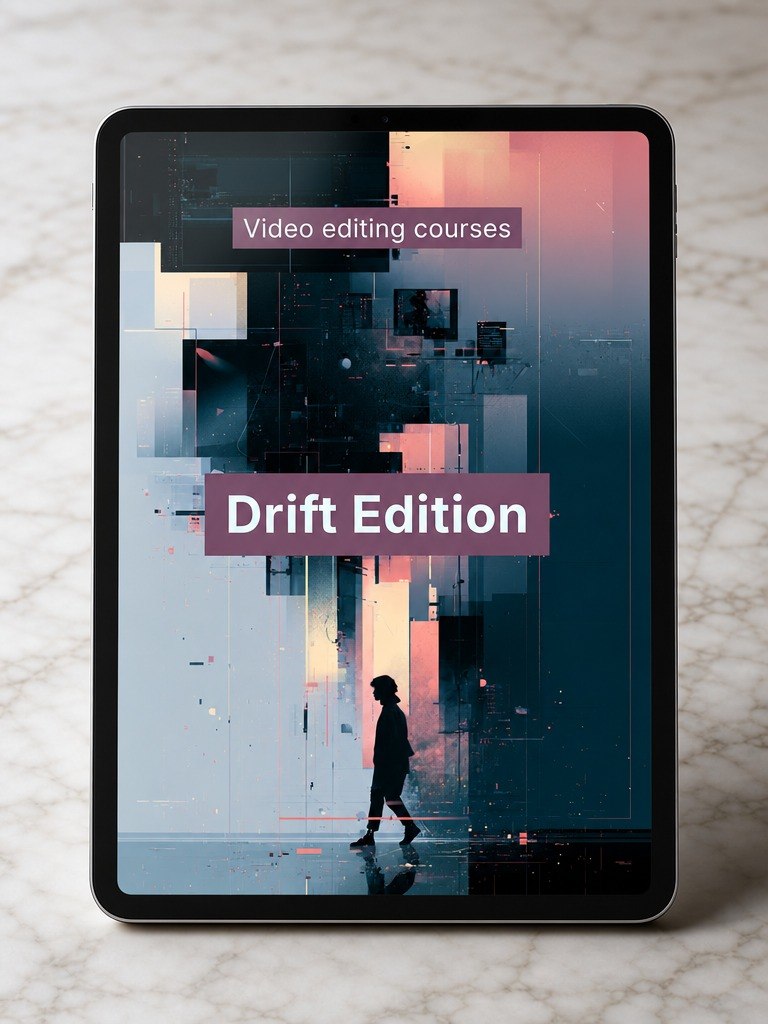
Clipvionixa
Drift Edition
Drift Edition
- 💾 Digital file available after purchase
- 📅 Long-term availability
- 🔒 Secure checkout
- ✨ Content updated in 2026
Self-paced learning overview
1. Problem Statement
When a scene consists of many fragments, it is important not only to place frames correctly but also to preserve a sense of continuous movement. Sometimes an episode begins calmly, then suddenly becomes too dynamic, and then loses pace again without a clear reason. These changes can feel random when there is no smooth internal logic between the parts. It can also be difficult to combine different moods, action speeds, and visual density within one episode. Drift Edition helps learners view editing as scene movement through pace, mood, and connected transitions.
2. Solution
Drift Edition explains how to build a smooth change of states within an episode. You learn how pacing, pauses, movement, light, and composition can work together so the scene does not feel disconnected. The materials help analyze where a softer transition is needed, where a rhythm change is appropriate, and where more space for perception may be useful. Special attention is given to connections between scene parts and reviewing the overall episode flow. This tier helps learners work with editing not only as a set of frames, but as a continuous movement of attention.
3. What's Inside
- Module 1: Flow Mapping — how to see a scene as continuous movement from beginning to end.
- Module 2: Mood Shift Logic — how to connect different moods within one episode.
- Module 3: Soft Transition Planning — how to plan transitions that do not feel unnecessarily abrupt.
- Module 4: Pace Drift Control — how to manage pace changes between calm and dynamic parts.
- Module 5: Pause Placement — how to use pauses as part of editing logic.
- Module 6: Visual Density Balance — how to combine visually rich and simpler frames in one flow.
- Module 7: Sequence Breathing — how to give a scene enough space so the material does not feel compressed.
- Module 8: Flow Review Method — how to review an episode through smoothness, pacing, and mood changes.
4. Who is this for?
✅ A good fit if you...
- already understand basic scene structure, movement, and layered work;
- want to work more carefully with transition smoothness;
- notice that some episodes feel disconnected in mood or pace;
- want to learn how to connect calm and dynamic parts;
- want to analyze a scene as one continuous flow, not separate fragments.
❌ Not for you if...
- you only need introductory editing material;
- you do not plan to work with pace, pauses, and mood;
- you need ready-made template solutions instead of learning materials;
- you expect materials tied to specific software names;
- you are looking for a course only about technical frame trimming.
5. What You'll Learn
- See an episode as a continuous flow rather than separate frames.
- Analyze mood changes between parts of a scene.
- Plan softer transitions between different fragments.
- Manage pacing between calm and dynamic parts.
- Use pauses as part of editing logic.
- Balance visually rich and simpler frames.
- Check whether a scene feels compressed or disconnected.
- Create an episode with a smoother internal structure.
6. Refund Terms
- 30-day money back
1. What format do the courses use?
1. What format do the courses use?
Clipvionixa courses are presented as structured learning materials with modules, explanations, practical tasks, and examples for self-guided study. Each tier has its own depth, topic range, and level of detail.
2. Are these courses suitable for beginners?
2. Are these courses suitable for beginners?
Yes, some tiers are created for learners who are just getting familiar with editing and want to understand the basic logic of frames, scenes, and rhythm. Higher tiers include broader topics for learners who already have a basic understanding of the process.
Couldn't load pickup availability
Share